 pannigeriannews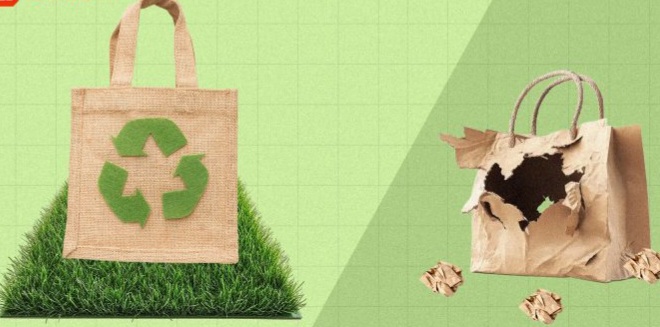
CREATOR: gd-jpeg v1.0 (using IJG JPEG v62), quality = 82?
By Akinwande Soji-Ojo
A University of Ibadan (UI) student, Ifeoluwa Garba, has developed a method of converting waste grass into biodegradable paper bags, a venture that has evolved into Ecobag Mart, a three-man startup tapping into Africa’s growing packaging industry.
Garba, who initially missed out on studying Mechanical Engineering and was instead admitted into Wood and Biomaterial Engineering, said the detour unexpectedly provided the foundation for building an environmentally sustainable business.
According to techcabal, he showcased his innovation at the UI SME Fair in November 2025, where he pitched to hundreds of participants.
The idea, he explained, was sparked by his frustration with waste and packaging systems in Africa, as well as insights gained from Afrotalks, a think tank that promotes African-led solutions.
“Africans are leaving the diaspora back to Africa, and they want to make sense out of Africa. I began to perceive that this was already happening,” he said.
Medical outreach inspired the innovation
Garba traced the inspiration for Ecobag Mart to a 2022 medical outreach trip to Epe village in Osun State. He recalled travelling past heavy drilling machines and deep pits into a community where residents lived in extreme poverty.
“Malnourished children, collapsing houses, no infrastructure, no schools, no opportunities. Nigeria exports wealth, but the communities closest to the resources remain the poorest,” he said.
Driven by curiosity rather than profit, he began experimenting ways to turn dried grass into paper after seeing a video on the process.
Although his lecturer initially discouraged using a short, resilient type of grass, Garba said continued experimentation proved the material viable.
He later abandoned grass collection due to logistical difficulties and switched to readily available agricultural waste. After several iterations, he secured a patent for his formula.
Building with limited capital
To scale production beyond the manual process, Garba said he built a low-budget factory and acquired basic machinery despite limited funding.
As operations expanded, he brought in two co-founders: Olawale Omofojoye, who manages raw material sourcing, and Christabel Egbegi, an environmental expert who offers advisory support from the UK.
“Getting a team was one of the challenging parts. I was basically going nuts trying to manufacture and go for pitching competitions. I needed friends who could fill in a few spaces,” Garba said.
Garba, Omofojoye and Egbegi
Testing the Ecobag
Ecobag’s prototype has a rough, sturdy texture influenced by the current processing machine. Garba said smoother textures would be possible with more advanced machinery. The bag’s handles, also made of paper, were designed to keep the product fully biodegradable.
Growing recognition and funding
Ecobag Mart has gained traction through social media, exhibitions and pitching competitions. Garba said a short Instagram video from a contest generated several enquiries. At the Global Exhibition event, food and cosmetic companies also indicated interest in the cheaper alternative to conventional paper bags.
The company has won awards at Innotech 3.0 and the Cleva App Business Challenge (YC 2024), where Garba earned the Most Innovative Award and a $250 prize. He also participated in an eight-week entrepreneurship programme sponsored by the British Council and King Trust International, often shuttling between Ibadan and Abeokuta while balancing exams and sleeping on floors to attend sessions.
Garba at Cleva Business Challenge
Looking ahead
Garba said the company is now focused on improving the physical appearance of the bags and increasing production.
He believes Ecobag Mart can evolve from a prototype stage into a scalable business that demonstrates how local innovation can address global challenges such as waste management and sustainability.
“We’re committed to making this work. This thing can actually work out,” he added.
Source:
Newspeakonline


About The Author