 pannigeriannews
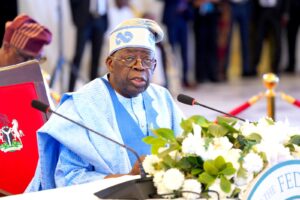
Something appears nailed on certainty: That we will have a president and commander in chief take the oath of office in 2027. Who would it be? It is for now tilting heavily towards a repeat for President Bola Ahmed Tinubu. This might not be the thinking of many people, but the game we are all watching points to this and his political party, the All Progressives Congress (APC) has ensured all grounds are covered. Beyond covering major grounds by the APC, the mines laid everywhere in the way of Tinubu’s probable opponents are also a disturbing factor. However, the Divine is one huge factor we seem to overlook, a factor way bigger than everything else under consideration in this matter.
Meanwhile, one thing is almost all in human hands: Bí o báku oba atialágbèdenikan, enikannínú won o feinashani.
When we are left with only the king and the blacksmith, one of them must take up the duty to kindle the fire in the forge. In other words, one of the two must play the role of a blower. We are confronted by one clause in the amended Electoral Law 2026 which has left Nigeria and concerned Nigerians in a sort of quandary.
Now that those concerned Nigerians are left with the courts and the Nigerian civil society as one particular, united entity, someone must take the bull by the horns in this situation. The fire must be kindled, and someone must take that all important responsibility of kindling the fire between the two people available: king and the blacksmith.
We must now leave those representatives of ours at the National Assembly to their inexplicable games and antics and look elsewhere for answers to our questions as a people. If we rely on some of our so called honourable members found in the two chambers of Nigeria’s National Assembly for a solid foundation to build a nation, the country will extinguish like a blacksmith’s forge left unattended.
Those yes men honourable members are proving to be typical politicians, the etymological basis for the phrase: “A confusion of politicians.” And as they are led by the nose in their dealings, they have continued to act happily as mere politicians who would do anything but be seen as honour able and statesmen.
Why? Our ‘honourable members’ and senators appear to be the only ones among the citizenry who do not seem to understand the wider and long term implications of that clause about certificate forgery in the Electoral Amendment Act 2026. Nigerian lawmakers deleted a section of the 2022 Electoral Act and replaced it with another clause which has riled many Nigerians, because of what it has allowed and what it has disallowed as politicians jostle for political offices.
In the Electoral Amendment Act 2026 our lawmakers came up with and agreed on the alteration of Section 134 of the 2022 Electoral Act. They went as far as replacing it with the new Section 138 of the 2026 Act. They didn’t end it there, they deleted Section 134(3) of the 2022 Act, which, from a lay man’s point of view, allows candidates to question the qualifications of other candidates within or outside their own political parties. The basis for questioning the qualifications of other candidates is usually based on the constitutional provision on such matter. We have often heard about court cases that originated from issues of the qualification or otherwise of candidates in election petitions, and it is only moral and of course constitutional that when there are allegations that a candidate does not meet standard set for all of us as Nigerians in the 1999 Constitution of the Federal Republic of Nigeria for elective office, such should be challenged.
However, that controversial amendment of the 2022 Electoral Act by the National Assembly threw up more issues than were expected. For instance, those protesters at the National Assembly, who were fighting for how election results should be transmitted were oblivious of many other things in the Act. While the protesters focussed on their lone demand that the Senate must ensure the inclusion of mandatory electronic transmission of election results in the amendment, the lawmakers quietly removed Section 134(3) of the 2022 Act through which they could be challenged for certificate fraud. Clever indeed.
On a graver scale, but which came upon us quite innocuously and began its obnoxious existence in our electoral laws, the deleted Section 134(3) held more for us as a people. That deleted section deals with more than forged certificates. In addition to the submission of forged certificates to the electoral commission, that section also handles issues of falsification of age, sponsorship by a political party, citizenship, court convictions for an offence of dishonesty within a period of less than 10 years, health, especially mental health and so on. But the entire Section 134(3) has been removed. Would we say that deleting the provision which seems to keep our politicians on the prop of morality is a good act by expected statesmen? My answer to this is no. rather than deleting that provision, it should have been amended for improvement to strengthen that provision as the constitution expects. The constitution in Section 4(2) charges these lawmakers to make laws for the peace, order and good governance of Nigeria. This is simply not what the constitution expects of our lawmakers, because what they did with that section of the 2022 Electoral Act will impugn on order and good governance of Nigeria.
Now that the lawmakers have done what they will, Nigerians have the duty to undo it. We are duty bound to take on the new Act the 2026 Electoral Act Amendment because it is meant to detract from our quality of life and the good image of the country. Or how would you expect observers to take our country where certificate forgers, people of questionable character or even people with poor mental health or unsound mind, are freely roaming the corridors of power or are the ones forming the government?
With such latitude, Nigeria is done for. And that is courtesy of our “distinguished” senators and “honourable” members of the House of Representatives.
If Nigerians allow this utter disregard for morality to stand, then every other thing we are doing about building a society of honest people and to do away with certificate forgery and falsification of credentials, amounts to foolery. The killing of integrity and the encouragement of fraud by these lawmakers really rankles the brain. It is a classic example of law without morality. Recently, the Federal Government established Nigeria Education Repository and Databank (NERD) to help in preventing certificate forgery and crackdown on those apprehended. The Minister of Education, Dr. Tunji Alausa said NERD was “a necessary step towards protecting the credibility of Nigeria’s education system.”
It is obvious that one arm of government is coming up with strategies and institutional means to tackle certificate forgery and thereby protect the Nigerian education system.
Another arm of government, the one which is supposed to be the bastion of democracy, is busy creating avenues through which certificate forgers, criminals and people of questionable character as well as those without sound minds are getting into governance and getting away with it. It is as shameful as it is troubling, and we appear to be helpless.
But are we totally helpless? I don’t think so, because when we are left with only the king and the blacksmith, someone must kindle the fire of the forge. Organised civil society groups must rise to the occasion and save Nigeria’s democracy from its enemies. It is now a matter of urgent public importance, to borrow the language of lawmakers.
The Senate just threw Nigerians a curveball but the House of Representatives can straighten this and give Nigerians something to cheer for. It is achievable and we must all join hands to see this happen.


About The Author