 pannigeriannews
The Federal Government said it is strengthening regulation of Nigeria’s scrap metal industry to curb infrastructure vandalism, promote responsible recycling and protect legitimate businesses.
This is contained in a statement issued by Head of Press and Public Relations of the Ministry of Steel Development, M.A. Tine-Iulun on Tuesday in Abuja.
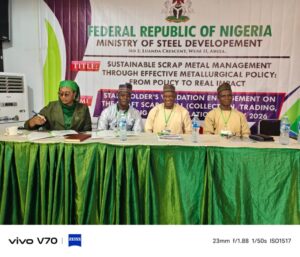
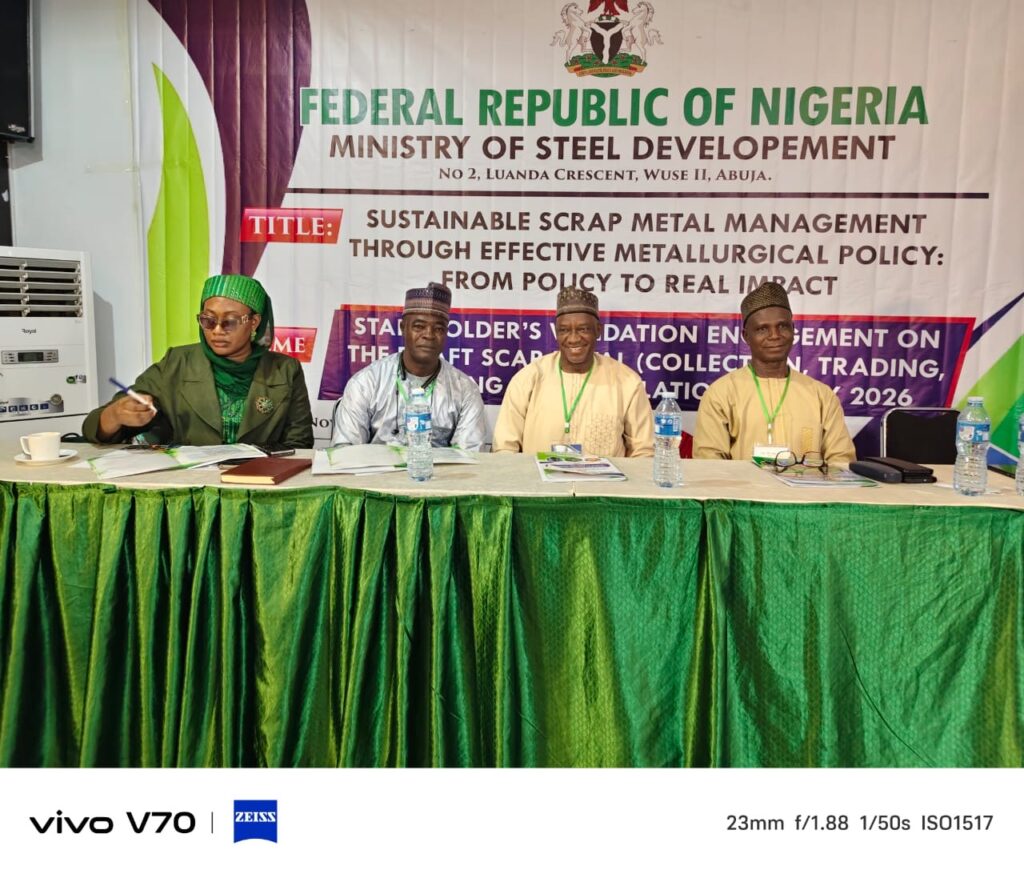
The statement said the Minister of Steel Development, Shuaibu Audu, disclosed this at the second phase of stakeholders’ engagement on the Draft Scrap Metal (Collection, Trading, Recycling and Regulation) Regulations in Kano.
Audu, represented by the Director, Steel and Non-ferrous Metals Department, Umar Tsoho, said effective regulation would support steel production, employment generation and sustainable industrial development.
Speaking under the theme, “Sustainable Scrap Metal Management through Effective Metallurgical Regulation: From Policy to Real Impact,” he described scrap metal as an important resource for Nigeria’s industrial growth.
He said an organised scrap metal value chain was necessary to developing a competitive steel industry, warning that poor regulation could encourage infrastructure vandalism and economic losses.
Audu said the proposed regulations would establish a system for licensing operators, monitoring collection centres, tracking transactions and enforcing environmental and occupational safety standards.
The minister said the framework would also address the illegal acquisition and sale of metals taken from public infrastructure, industrial facilities and other protected assets.
He identified electrical cables, railway components and manhole covers among public assets frequently targeted, noting that their theft disrupted essential services and increased maintenance costs.
Audu said the regulations were not intended to discourage legitimate businesses or threaten the livelihoods of scrap metal collectors and traders.
He explained that the framework would provide practical formalisation arrangements for small-scale operators while requiring larger recycling and processing facilities to meet appropriate standards.
The minister said the Kano engagement followed the first phase held in Lagos from Nov. 9 to Nov. 10, where stakeholders examined provisions covering licensing, operator classification, traceability, environmental protection and enforcement.
He assured participants that contributions from both engagements would be reviewed and harmonised to improve the proposed regulations.
In his remarks, the Permanent Secretary of the ministry, Amb. Nura Rimi, said the consultations were intended to ensure that the regulations reflected industry realities and stakeholders’ concerns.
Rimi, represented by Mr Christopher Wange, Director, Metallurgical Inspectorate and Environmental Protection Department, said the framework would address gaps in licensing, traceability, safety standards and enforcement.
He urged stakeholders to provide practical recommendations on operator classification, security, environmental protection and inter-agency collaboration.
Similarly, the National Steel Council reaffirmed its support for the proposed regulations, describing them as important to economic growth and employment generation.
The council’s Acting Executive Secretary, Aminu Shehu, made this known through Nana-Firdausi Muhammad, Head, Planning, Research and Statistics Department.
Also speaking, the Nigeria Security and Civil Defence Corps (NSCDC) pledged to collaborate with the ministry and other stakeholders to protect critical national infrastructure.
The Kano State Commandant, Mohammed Agalama, who represented the Commandant-General, Prof. Ahmed Audi, said effective regulation was necessary to prevent the theft of electrical installations, pipelines and railway facilities.
NAN


About The Author