 pannigeriannews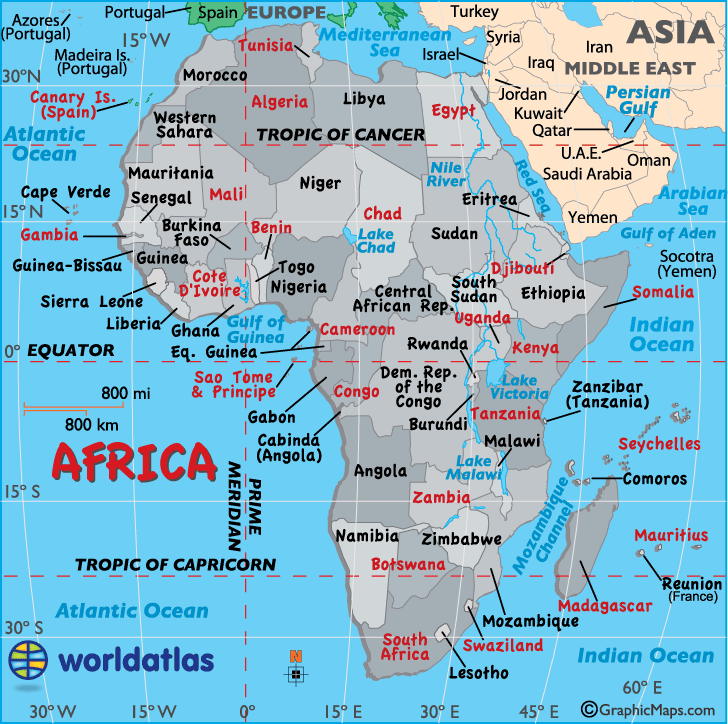
President of Burundi, Evariste Ndayishimiye has called for Africa’s permanent inclusion at the Security Council, saying inclusion would build trust between Africa and other continents.
The call adds voice to the long-standing demands for UN Security Council reform, which currently has five permanent members: the United States, the United Kingdom, France, China, and Russia, all of whom hold veto powers.
Ndayishimiye, in his address to the world leaders at the ongoing General Debate of the 81st session of the General Assembly at UN headquarters in New York, highlighted his country’ position as the Chair of the African Union for 2026.
“We are here to convey a conviction: Africa must be listened to more, it must be better represented and more closely involved in the decisions that shape the future of our planet.”
The Human Rights Council is used to target specific countries, he warned, adding that the mandate of the Special Rapporteur on Burundi’s human rights situation was established without consultation with the Government.
Burundi respects human rights and fights impunity, he said.
According to him, Africa intends to be a full-fledged player and not a mere observer, called upon to applaud decisions in the development of which it has not been involved.
He emphasised the inclusion of a country from the continent as a permanent member of the UN Security Council.
“Peace remains the primary condition for development,” he added.
“To that end, Burundi is paying close attention to the security situation in the Great Lakes, Sudan, the Sahel and Somalia,” he said, underscoring the importance of finding “African Solutions to African problems”.
Ndayishimiye said there must be strengthened partnerships between the African union and the UN in view of a peaceful settlement of conflicts.
In addition, he said, Africa must not be sidelined on trade discussions
“Africa, with its 55 states and more than 1.4 billion inhabitants” cannot be sidelined from trade discussions.
On behalf of the Africa Union, he called for equitable representation within the World Trade Organisation:
”This is not a favour we are asking for, but justice we are demanding”, he said.
Domestically, he said Burundi was determined to become an emerging country by 2040 and a developed one by 2060.
He noted that partnership, specifically through investment, technology transfer and capacity building would be instrumental to this transformation.
Earlier at the opening of the global debate, President of the General Assembly’s 81st session, Khalilur Rahman, called for fairer representation at the security council.
He said the UN had grown from 50 Member States in 1945 to 193 today, but survival alone is not evidence of success.
“Africa remains without a permanent Security Council seat after eight decades, which must change as a matter of “fairness, justice” and credibility.
“When the Security Council works, the United Nations works,” he said.
Rahman further called for action, noting that after eight decades without a permanent African seat in spite of the continent’s central role in peacekeeping operations.
“Africa needs a seat at the table, not to be on the menu,” he said.
Similarly, the UN Secretary-General Antonio Guterres called for Security Council reform, saying that the continued absence of permanent African representation on the body was “unjust and indefensible.”
He said the 15-member Security Council’s composition no longer reflected today’s geopolitical realities and repeated his call for reform.


About The Author