 pannigeriannews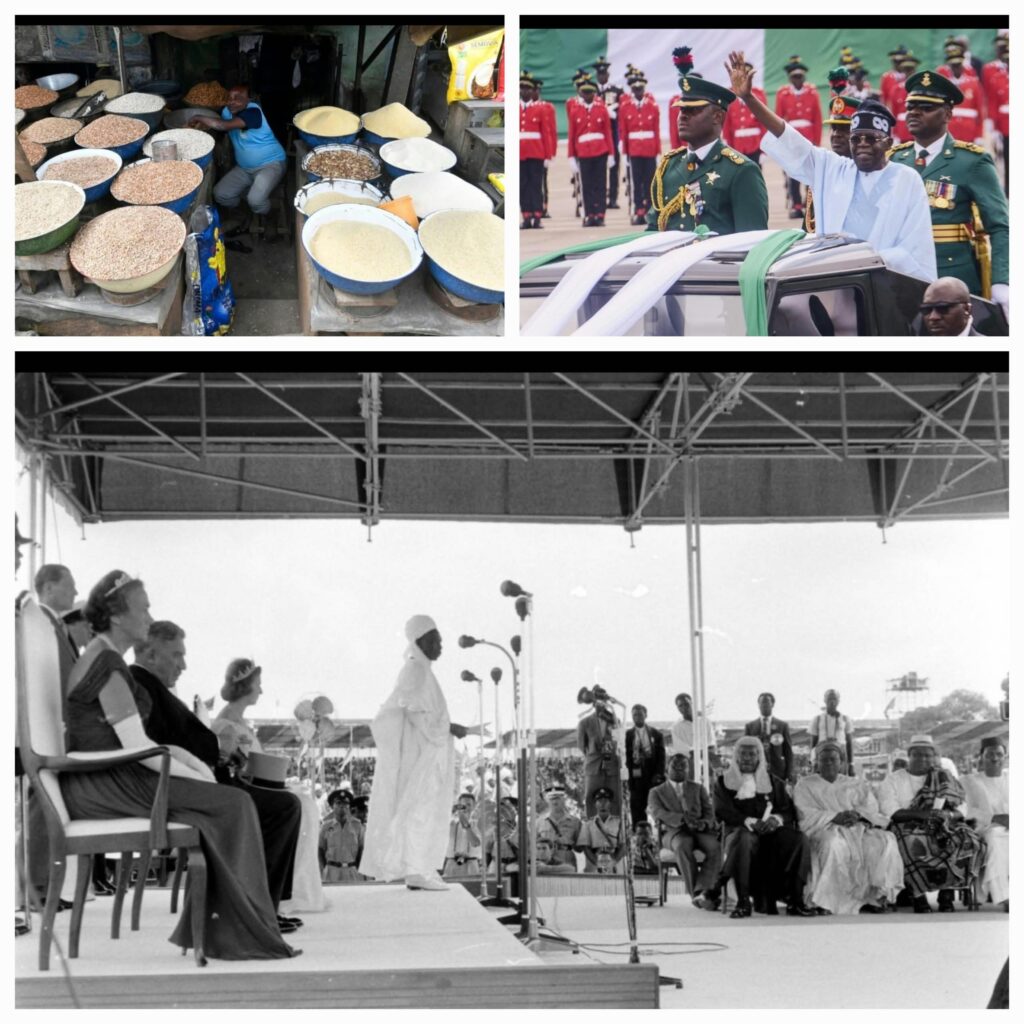
By Priscilla Iyabo Awojuola
What does independence mean to a generation measuring survival in the size of a ₦100,000 shopping basket?
“B’ọmọde ò bá bá ìtàn, a bá àrọ̀bà; àrọ̀bà ni baba ìtàn.”
There are some things we did not witness but must nevertheless understand.
I was not born in 1960.
I did not stand among the crowd when the Union Jack was lowered, and the green-white-green flag was raised on October 1 that year. I did not hear the speeches with my own ears. I did not see the faces of Nigerians who watched their country take its first steps as an independent nation.
But I have history.
I have the photographs.
I have the records.
I have the stories handed down by those who were there.
And, perhaps most importantly, I have the Nigeria that history has handed over to my generation.
As the Yoruba proverb reminds us, when we do not meet the story directly, we return to reflection, inquiry, and the accounts of those who came before us.
So, on Nigeria’s 66th Independence anniversary, I look backwards — not as someone who witnessed 1960, but as a Nigerian trying to understand what happened between the promise of that October morning and the reality of this October morning.
Perhaps nothing brings that reality closer to home than ₦100,000 in a Nigerian market.
₦100,000 AND THE MEASURE OF A NATION
I recently went to the market with ₦100,000. It sounded like a reasonable amount of money when I set out. By the time I returned, however, the money had been transformed into a few bags of household provisions.
Rice.
Beans.
Garri.
Vegetables.
Cooking oil.
Seasonings.
And other necessities.
Nothing extravagant.
Nothing luxurious.
Just the ordinary things a household needs.
Yet, as I looked at what the ₦100,000 had bought, one thought kept returning to me:
How did ₦100,000 become so small?
That was not an economic seminar.
It was not a presentation by an economist.
It was not a government statistic.
It was simply my shopping experience.
But sometimes, the market explains the economy better than a long speech.
Because behind every inflation figure is somebody standing before a trader, calculating.
Behind every economic policy is somebody deciding what to remove from the shopping list.
Behind every increase in the price of food is a mother asking what the family will eat.
Behind every rise in transport fares is a worker calculating whether the journey to work is still worth the cost.
And suddenly, my ₦100,000 became more than money.
It became a measuring tape.
It measured purchasing power.
It measured the cost of survival.
It measured the distance between what we earn and what we need.
And, in a strange way, it measured the distance between the Nigeria we inherited and the Nigeria we are becoming.
THE NIGERIA I DID NOT SEE
I did not see Nigeria become independent. But history tells me what happened.
On October 1, 1960, Nigeria emerged from colonial rule as an independent nation.
There were challenges.
There were differences.
There were political tensions.
There were uncertainties about the future.
But there was also hope.
A belief that a country blessed with fertile land, natural resources, and a remarkably gifted population could build a prosperous future.
The people who witnessed that moment could not have known the Nigeria we would become.
They could not have imagined smartphones, social media, Afrobeats becoming a global force, digital banking, online businesses, or Nigerian entrepreneurs building across continents.
But neither could they have imagined that six decades later, one of the most common conversations in Nigerian homes would be:
“How much is it now?”
FROM BUILDING TO SURVIVING
This is where history meets the present.
The Nigeria of the early post-independence years was imperfect, but there was a powerful developmental imagination.
Today, the national conversation often sounds different.
How do we survive?
How do we pay rent?
How do we feed the family?
How do we keep the business alive?
How do we pay school fees?
How do we cope with electricity costs?
How do we manage transport?
How do we make our salaries last?
At some point, survival stops being an emergency strategy.
It becomes a way of life.
And that is perhaps the most uncomfortable question Nigeria at 66 must ask:
Have we become too accustomed to surviving?
FELA’S OLD SONG, NIGERIA’S NEW REALITY
Decades ago, Fela Anikulapo Kuti gave the country a phrase that has stubbornly refused to become obsolete:
“ Suffering and Smiling.”
The Nigeria he sang about was not the Nigeria of 2026. But listen to the title again:
Suffering.
Smiling.
There is something haunting about how contemporary it can sound.
We suffer.
We smile.
We attend weddings.
We celebrate birthdays.
We dance.
We laugh.
We say, “It is well.”
Then we go home and calculate.
What is left?
What bill can wait?
What food can we remove?
What can we postpone?
What can we do without?
This is not to say that Nigerians have lost hope.
Far from it.
Perhaps our greatest national strength is that we continue to hope even when hope is expensive.
66 YEARS OF CONTRASTS
The Nigeria of 1960 and the Nigeria of 2026 are separated by 66 years. But the contrasts are striking.
Then, agriculture was central to the economy.
Today, we speak of diversification while food prices remain a daily concern.
Then, the nation was beginning its journey with enormous expectations.
Today, millions of young Nigerians are asking whether their future lies at home or somewhere else.
Then, independence represented freedom from colonial rule.
Today, Nigerians increasingly speak of another kind of freedom:
freedom from hunger, insecurity, unemployment, poverty, and economic hopelessness.
Then, the national question was:
“What will we build with our freedom?”
Today, for many households, the question is:
“How do we make it through the month?”
That is the contrast we can not ignore.
THE GOVERNMENT’S STORY AND THE PEOPLE’S STORY
President Bola Ahmed Tinubu’s Independence Day message presented a country undergoing economic reform, with the administration pointing to improving growth, macroeconomic stability, and the prospect of shared prosperity.
That is an important part of the national story. But there is another part.
The story told by the market.
The story told by the roadside trader.
The story told by the worker.
The story told by the pensioner.
The story told by the young graduate.
The story told by the parent standing before a school administrator with a fee bill.
These stories should not necessarily be treated as competing truths.
They are different windows into the same country.
The economy may show signs of improvement while households are still struggling with the accumulated burden of higher prices. That is why the question ordinary Nigerians ask is not simply whether inflation is falling.
They want to know:
When will life become easier?
THE COUNTRY WE INHERITED
Nigeria has not stood still.
We have achieved much.
We have survived a civil war.
We returned repeatedly from military rule to democratic government.
We have produced outstanding professionals, entrepreneurs, scientists, artists, writers, athletes and innovators.
Our music crosses borders.
Our films travel.
Our businesses expand.
Our people excel wherever opportunity meets talent.
Nigeria remains a country of enormous possibility. But possibility is not the same as prosperity.
Potential is not the same as performance.
And, resilience is not the same as wellbeing.
We should celebrate what Nigeria has achieved. But we should also be brave enough to ask what remains unfinished.
THE ₦100,000 AGAIN
And so I return to where I started.
The market.
The ₦100,000.
The bags.
The prices.
The calculations.
That is my Nigeria at 66.
Not the entire Nigeria.
But one small window into it.
I can not tell you what it felt like to stand at the independence ceremony in 1960.
History must tell that story.
But I can tell you what it feels like to walk into a Nigerian market today with ₦100,000 and walk out wondering how quickly it disappeared.
That is my generation’s story.
And perhaps another generation will tell a different one.
That is the hope. That, today’s children will someday look back at 2026 the way we look back at 1960 — as another chapter in a long national story.
But what will they say about us?
Will they say we merely survived?
Will they say we complained?
Will they say we adapted?
Will they say we built?
Or will they say that somewhere along the way, Nigerians finally decided that resilience alone was not enough?
66 YEARS ON
The Nigerian flag is still flying.
That matters.
The country is still here.
That matters, too.
But independence is not only the story of a flag.
It is the story of what happens beneath that flag.
Can people eat?
Can they work?
Can they afford to live?
Can they educate their children?
Can they access healthcare?
Can they sleep without fear?
Can a young Nigerian dream without immediately calculating the cost of leaving the country?
Can hard work lead to a decent life?
These are the questions that give independence its everyday meaning.
Six decades ago, our forebears received political freedom.
Our responsibility is to ensure that freedom eventually produces human dignity and shared opportunity. Perhaps that is the unfinished business of independence.
THE STORY IS STILL BEING WRITTEN
The Yoruba proverb says:
“B’ọmọde ò bá bá ìtàn, a bá àrọ̀bà; àrọ̀bà ni baba ìtàn.”
I did not meet the Nigeria of 1960.
But I have met the Nigeria of 2026.
I have seen its beauty.
I have seen its contradictions.
I have seen its resilience.
I have seen its hardship.
And, yes, I have stood in a market with ₦100,000 and wondered what happened to the purchasing power that money once represented.
Perhaps that is why Independence Day should not only be a day of celebration.
It should also be a day of reflection.
Because history is not merely about where we came from.
It is a mirror held up to where we are going.
At 66, Nigeria has survived much. But survival should not be the final destination.
We should be able to move from survival to stability, from stability to prosperity, and from prosperity to a society where dignity is ordinary rather than exceptional.
Fela asked us to look at a people suffering and smiling.
Sixty-six years after independence, perhaps the question before us is whether we are finally ready to stop measuring national success by how much hardship Nigerians can endure.
The flag has been flying for 66 years. What we do beneath it now is the story history will tell about us.
Sixty-six years after the flag went up, Nigeria is still work in progress. Th3 question is no longer whether the country has potential.
We know it does.
The questions are:
When will potential finally become the everyday reality of the Nigerian people?
What story are we writing for the generation coming after us?
66 years on, what do you think – have we moved forward, merely survived, or are we still waiting for the Nigeria promised in 1960?
Happy Independence Day, Nigeria.


About The Author